


I am pleased when walking in a labyrinth of my own raising, not to know whether
the next tree I shall meet is an apple or an oak, an elm or a pear.
Joseph Addison; The Spectator, 1712
SHADE TREES
We are blessed with a large selection of Shade Trees this year.
XL Stock
‡ The symbol indicates a plant which this year comes in extra-large as well as the maximum size (1.6m) allowed by Canada Post. The price is the same, but you'll have to come & pick 'em up.
Our Fall pick-up date is Saturday, October 6th, 2007. Please see Specials or this map to Marlbank for directions.
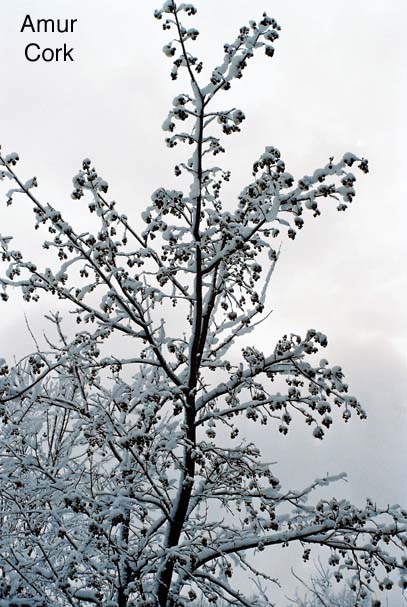
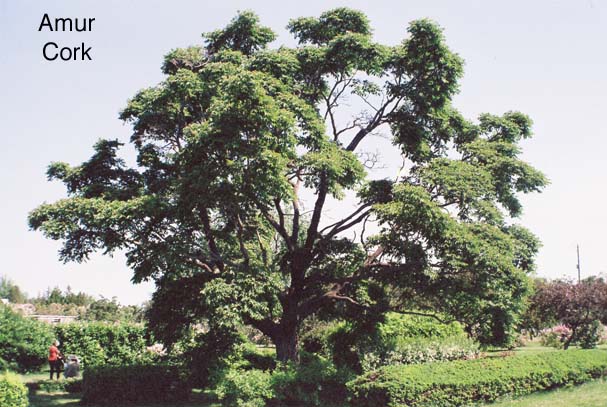 Phellodendron amurense
AMUR CORK Z3b/11m ‡
From N.E. Asia. Dark feathery leaves. Tropical in appearance, with beautifully textured bark. Its medium shade does not compete with lawns. Clusters of black berries hang well into winter attracting wildlife. Competes well with coarse shrubs in shelter belts. Good for mid-ground under taller trees. Fine specimens at the Jardin Botanique de Montreal & the Dominion Arboretum, Ottawa. "Tolerant of a variety of soils. Withstands city conditions and drought... rapid growth... transplants readily. Few pests."
H.O. Perkins, Ornamental Trees
80-150cm $12 each 3 for $30
Celtis occidentalis
HACKBERRYZ3/15m ‡
Because of its vase shape & disease
resistance, Hackberry makes the best
native replacement for Elm. Crown is
almost as wide as the tree is tall. Tiny
flowers followed by small, dark, edible
fruit of importance to overwintering
birds. Its deep drought-resistant roots
permit an underplanting of shade
tolerant shrubs.
80-200cm $12 each 5 for $40
The best time to plant a tree was thirty years ago. The second-best time is now.
-Proverb
MAIDENHAIR GINKGO Z5/14m
Thought to be extinct in the age of the dinosaurs, re-discovered in a Chinese temple in the 19 century. Untroubled by modern pests, pollution tolerant & adaptable to any well-drained soil. Unusual fan-shaped leaves. Called 'Yin-Hing' or Silver Apricot by the Chinese. An ancient specimen in Korea is the largest tree in Asia.
40-60cm $12 each 3 for $30
Gymnocladus dioicus
KENTUCKY COFFEE TREE Z4b/11m
Dangling seedpods, akimbo limbs & long feathery leaves make this Appalachian native interesting in all seasons. Its shiny brown seeds resemble coffee beans but are not edible. Root nodules contain nitrogen-fixing bacteria which enrich the soil.
20-40cm $12 each 3 for $30
In Norse sagas, the river of fate rises from beneath the Ash.
Fraxinus nigraBLACK ASH Z2b/16m
The northernmost Ash, named for its shiny blue-black buds & dark heartwood. This slender, long-boled water lover also flourishes on upland moraines. Dislikes shade. The preferred ash for basket making. Golden fall foliage.
40-80cm $10 each 3 for $24
Gleditsia triacanthos f. inermis
THORNLESS HONEY LOCUST Z4/14m
Delicate leaves give a light shade and disappear without raking. A rapid growing native Appalachian, Honey Locust is hardy in our mid-north where its ferny form looks almost African. In the pea family, its roots fix nitrogen. Interesting long twisted seed pods.
40-60cm $10 each 5 for $40
MAPLE
Acer pennsylvanicum
STRIPED MAPLE Z2b/3m ‡
Shy native: grows in isolated groves throughout the N.E. yet few have ever seen it. Chalk stripes hi-lite the greenish bark. Autumn leaves glow with amber. Ideal for rock gardens or small shaded areas. Prefers slightly acidic granite soils. Excellent cottage tree.
60-120cm $10 each 5 for $30
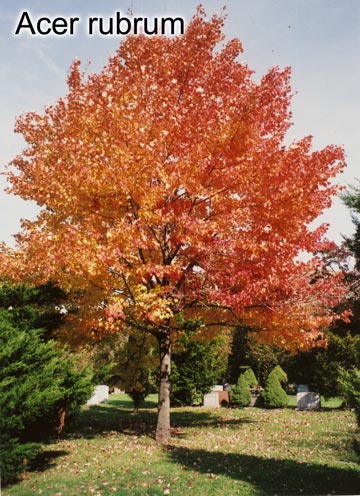 Acer rubrum
RED MAPLE Z4/14m
Pale bark, delicate leaves & a refined
form. The most popular landscape
maple. Though cold tolerant & wide
ranging, it grows sparsely, almost
elusively, in woods and marshes.
Brilliant scarlet leaves in autumn.
60-100cm $12 each 3 for $30
Acer glabrum
ROCKY MOUNTAIN MAPLE Z5b?/5m
Narrow-topped, often multi-stemmed shrub maple found along the Rockies from Alaska to California. Leaves shining above, pale beneath, on attractive reddish stalks. Useful ornamental. Rarely offered in the east.
60-80cm $12 each 3 for $30
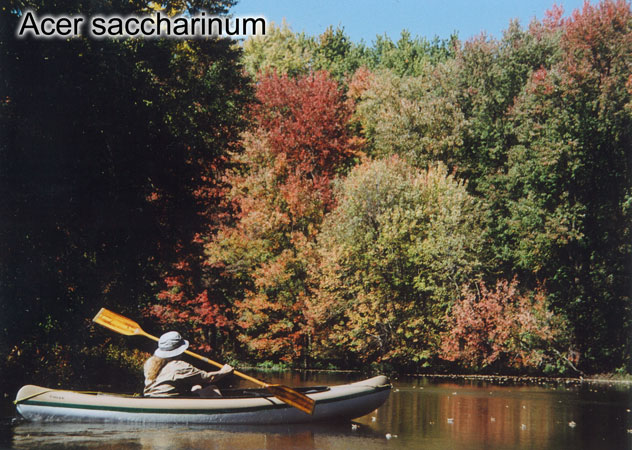
Silver Maples, Salmon River, October.
Acer saccharinum
SILVER MAPLE Z3/25m ‡
Eminent dampland maple from the heart of its range in E. Ont. Tall arching Elm-like form. Gorgeous red-grey, slightly upcurled bark. A few fine examples are still left in Loyalist villages where their grace, beauty and usefulness remind us of a past harmony.
80-150cm $10 each 5 for $30

The cheerful flower and bright spring leaves of the compact-sized Argutum Maple from N.E. Asia
Available spring 2008
MOUNTAIN MAPLE Z2b/4m ‡
Smallest of our Eastern Maples: tolerates shade & young mineral soils. Does poorly in the open. Red-grey bark, spring flowers & fall colours all very ornamental. Shallow rooted. Its delicate pink seed samaras are valuable to wildlife.
200cm $12 each 3 for $30
FOR PICK UP ONLY
Acer saccharum
SUGAR MAPLE Z4/22m Available Next Year
Edible sap and unequalled fall plumage. Shade tolerant when young. Excellent large landscape tree; solo or in malls. Grown on calciferous soil our Sugar Maples are unstressed by acid rain and will make strong replacements in damaged syrup groves.
BIRCH
 Betula ermanii
GOLDEN BIRCH Z4/12m ‡
"One of the finest & most graceful of all
trees," claims The Garden magazine.
Grows magnificently on loam, while on
thinner soils it bonsaiis itself into
curious shapes. Exfoliating creamy
gold bark & orange coloured
branchlets make it a landscaper's
favourite. From N.E.Asia.
80-120cm $12 each 3 for $30 10 for $75
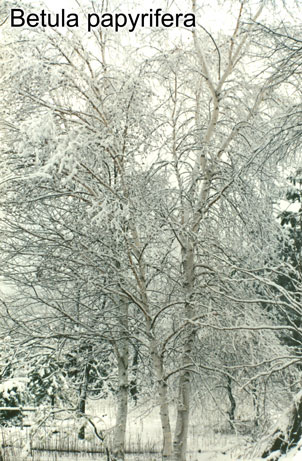 Betula papyrifera
PAPER BIRCH Z2/20m ‡
The northern landscape seems
incomplete without the dazzling bark of
the Canoe or Paper Birch. Considered
among the world's most beautiful
trees, this elegant native prefers cool
sites. Tolerates shade while young.
Unsuited to linear plantings: best in
pure groves hi-lighted against a stand
of conifers. Bark turns white around
the fifth year.
80-150cm $12 each 3 for $30 10 for $75
Betula populifolia
GRAY BIRCH Z3/12m ‡ FOR PICKUP ONLY
Good for decorating poor ground, damp or dry, the most drought-resistant & the smallest of the erect birches. Long male catkins. Leaves shiny on both sides & almost as tremulous as Aspen. Chalk bark crossed with dark triangles. Often multi-stemmed. A subtle beauty, seldom offered.
1-2m $12 each
Willow
A thing to take hot tempers out of us
is to go gardening boldly in the spring
... hoping the utmost of everything.
John Ridd in Lorna Doone
Salix babylonica
WEEPING WILLOW Z3/11m SOLD OUT ‡
A northern-hardy form of the classic weeping willow of art & legend. Long slender drooping branchlets romanticize any property. Prefers water nearby.
80-120cm $15 ea.
Salix babylonica 'Tortuosa'
CORKSCREW WILLOW Z5/8m
This well-named curiosity from N. China literally twists its slender limbs into corkscrews. With its bizarre genetics, small size and open form this tree offers an unusual backdrop to an intimate damp area.
60-80cm $12 ea.
I believe a blade of grass is no less than the journeywork of the stars.
Walt Whitman
Salix pentandra
LAUREL-LEAF WILLOW Z4/8m
Long, glossy leaves sparkle when lifted by a breeze. For a double-mint effect, plant near Silver Maple. Can prevent ravine erosion & stop ponds from slumping. Prairie hardy, originally from Lake Manitoba.
60-80cm $10 3 for $24